Most people in cybersecurity know what a Trojan is.
Far fewer stop to think about where the name actually comes from — and why the original story remains one of the greatest lessons in security ever told.
The Story of Odysseus
After nearly ten years of unsuccessful siege, the Greek army was unable to breach the mighty walls of Troy.
The city was simply too well defended. No matter how powerful the Greek warriors were, no direct assault succeeded.
Then came Odysseus.
Unlike Achilles, whose greatest strength was his sword, Odysseus won battles with intelligence, deception, and strategy. He proposed something completely different: stop attacking the walls altogether.
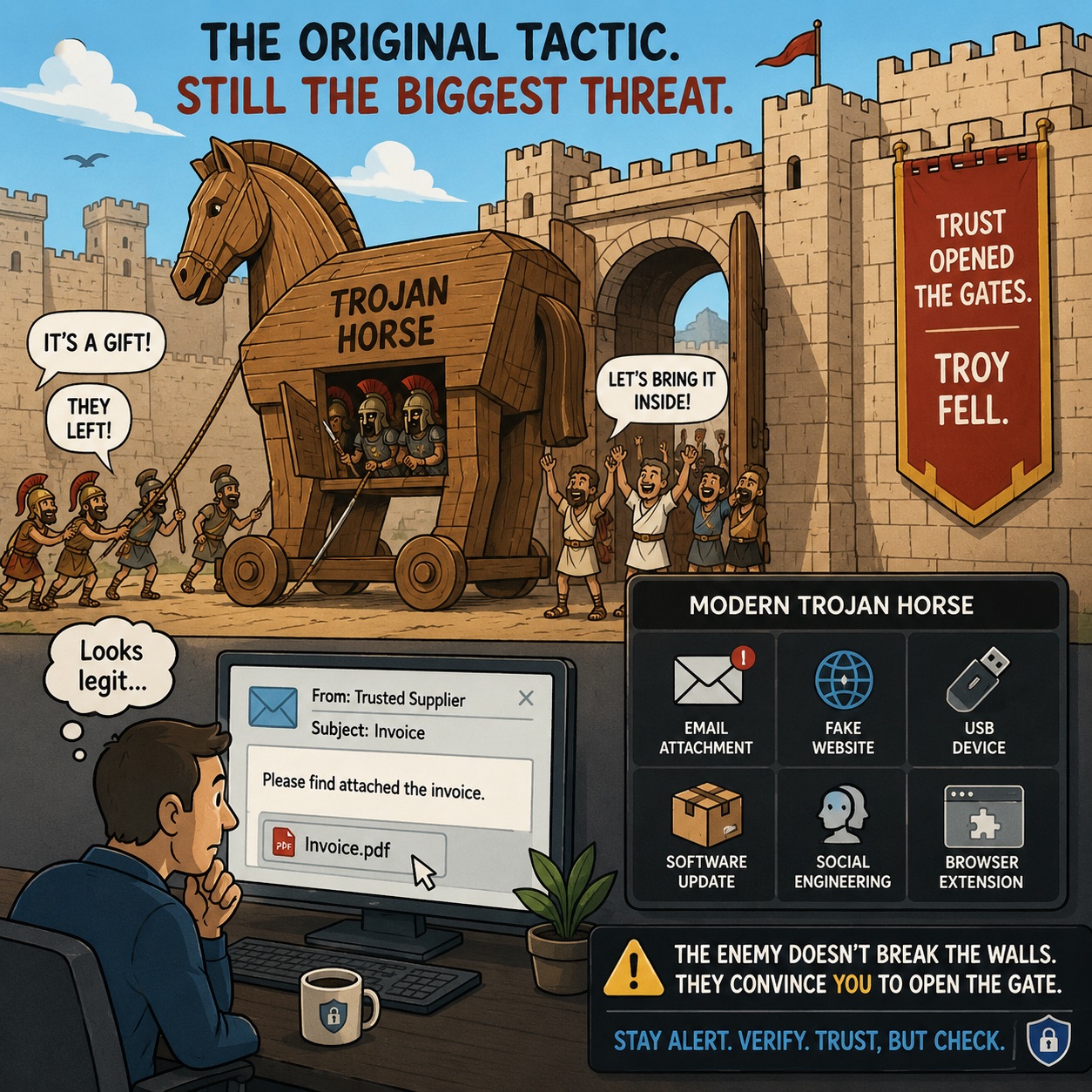
The Greeks appeared to abandon the war, sailing away while leaving behind an enormous wooden horse as a supposed peace offering.
The Trojans celebrated.
Despite warnings from a few who questioned the gift, curiosity, pride, and the belief that the war was finally over led them to bring the horse inside the city walls.
That single decision sealed Troy's fate.
Hidden inside the horse were elite Greek soldiers. During the night, they emerged, opened the city gates, and allowed the returning Greek army to enter. Troy was destroyed — not because its walls failed, but because it willingly invited the enemy inside.
Sound Familiar?
More than three thousand years later, our organizations often make exactly the same mistake.
Modern companies invest millions in:
- Firewalls
- Endpoint Detection & Response (EDR)
- Network segmentation
- Multi-Factor Authentication
- Security Operations Centers (SOC)
- Threat intelligence
These are today's city walls.
Yet attackers rarely waste time trying to break through them. Instead, they convince someone inside the organization to open the gate.
The Modern Trojan Horse
Today's Trojan Horse rarely looks suspicious. It arrives as:
- An email attachment from a trusted supplier
- A fake Microsoft 365 login page
- A PDF invoice
- A software update from a compromised vendor
- A browser extension
- A free productivity application
- A USB drive left in the parking lot
- An AI-generated message that sounds exactly like your CEO
Everything appears legitimate. The user voluntarily downloads it. The system willingly executes it. The attacker now operates from inside the trusted environment.
The walls remain intact. Just like Troy.
Technology Isn't Enough
One of the biggest misconceptions in cybersecurity is believing that security is primarily a technology problem.
It isn't. It is a trust problem.
The Trojan Horse succeeded because the Trojans trusted something they should have questioned. Modern cyberattacks succeed for exactly the same reason.
Attackers understand psychology better than technology. They exploit:
- Curiosity
- Urgency
- Authority
- Fear
- Greed
- Familiarity
- Trust
These human traits haven't changed in thousands of years. Only the delivery mechanism has.
What Odysseus Would Teach Security Teams
If Odysseus were alive today, he probably wouldn't spend months trying to bypass your firewall.
He would study your employees. He would learn your suppliers. He would impersonate someone you trust. He would find the one process everyone assumes is safe. He would create something your organization wants to bring inside.
Because that's always been the shortest path.
The Real Lesson
The story of the Trojan Horse reminds us that the strongest defenses can become irrelevant when trust is exploited.
Security isn't just about building higher walls. It's about understanding what you're allowing through the gate.
Every email. Every USB device. Every software download. Every third-party vendor. Every AI tool. Every click.
The next Trojan Horse probably won't be made of wood. It will arrive in your inbox. And, just like the original, its greatest weapon won't be force — it will be trust.
If you'd like to assess how well your organization can spot the next Trojan Horse before it's brought inside the gates, contact Lasetech. We help businesses combine technical controls with the awareness that actually stops social engineering.